

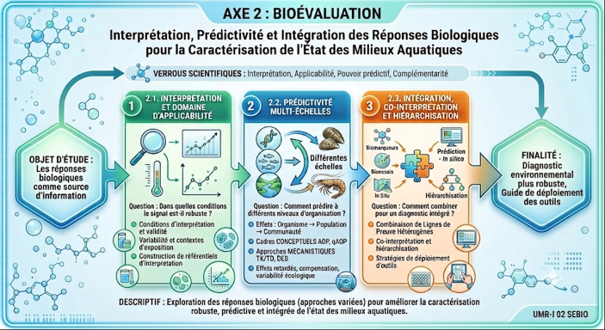
Axis 2 – Bioassessment: From Biological Signals to Environmental Status Characterization – Interpretation, Predictive Capacity, and Integration
Presentation
Subject of study: biological responses as a source of information on environmental status.
Scientific challenges: their interpretation, domain of applicability, predictive power, and complementarity.
Overall objective: to provide more robust environmental diagnostics and guide the deployment of tools according to bioassessment objectives
Description
Question – How can biological responses be mobilized and integrated to provide a robust, predictive, and integrated characterization of the status of aquatic environments?
Axis 2 investigates how biological responses, obtained through diverse and complementary approaches, can be used to improve the characterization of aquatic ecosystem status. Research focuses on the interpretation of biological signals, their domain of applicability, sensitivity, and ability to predict effects across relevant spatial, temporal, and biological scales. The objective is to better understand the complementarity of these approaches in order to develop frameworks for the co-interpretation of biological responses, prioritize their contribution to environmental diagnosis, and define deployment strategies adapted to different application contexts.
2.1. Interpretation and Domain of Applicability of Biological Responses
Question – Under which conditions can a biological response be robustly interpreted as an indicator of environmental status?
This sub-theme aims to define the conditions under which biological responses can be interpreted and their domain of validity for environmental status assessment. The goal is to identify how response variability and exposure contexts influence their robustness as environmental indicators. A major challenge is to establish clear links between biological signals and environmental status, notably through the development and use of interpretation frameworks, thereby ensuring the application of robust tools under ecologically realistic conditions.
2.2. Multi-Scale Predictive Capacity of Biological Responses
Question – To what extent can biological responses predict effects across different levels of biological organization and temporal scales?
This sub-theme examines the capacity of biological responses observed under controlled conditions (laboratory and field studies) to predict effects at higher levels of biological organization (organism, population, community) and over extended time scales. It seeks to identify mechanisms enabling extrapolation across biological levels, particularly through conceptual frameworks such as AOPs and qAOPs, and to strengthen mechanistic approaches (TK/TD and DEB models) that support robust effect prediction. A key challenge is to account for delayed effects, biological compensation mechanisms, and ecological variability under realistic conditions. This sub-theme also addresses the influence of environmental stressors that may modulate biological responses and alter the trajectories of toxic effects.
2.3. Integration, Co-Interpretation, and Prioritization of Biological Responses
Question – How can complementary biological responses be combined to build an integrated and prioritized environmental diagnosis of ecosystem status?
This sub-theme explores approaches for integrating heterogeneous biological responses to generate coherent and robust environmental information. It focuses on developing co-interpretation strategies that combine multiple lines of evidence, including biomarkers, bioassays, and in situ or in silico approaches, while prioritizing their contribution to environmental diagnosis. The objective is also to define methodological strategies for tool deployment according to bioassessment goals and the constraints of different application contexts.
The axis is coordinated by Benoit Xuereb
Thèses en cours
- EAT - Study of the feeding behavior in the common prawn Palaemon serratus (Pennant, 1777): Development of an in situ bioassay based on the feeding rate↳ par Julien GOURAND - plus d'info
- Estimation de la variabilité naturelle de la vulnérabilité des larves de crevettes palaemonidae pour le développement d’un bioessai de toxicité embryo-larvaire↳ par Jason JEANNE - plus d'info
- Etude des effets neuroendocriniens : analyse in vitro des mécanismes de perturbation des cellules cérébrales et hypophysaires chez le bar européen↳ par Manon LEFEVRE - plus d'info
- FACTORS : Impact of environmental and physiological factors on the response of mussels to pathogenic bacteria↳ par Jade MOURGUES - plus d'info
- Les systèmes de neurotransmetteurs chez les invertébrés et perturbation potentielle par les polluants environnementaux↳ par Marie Houédé - plus d'info
- PLASTICOP : Occurrence et impact environnemental potentiel des micro/nanoPLASTIques présents en estuaire - cas particulier de deux populations transatlantiques du COPépode Eurytemora affinis↳ par Céleste MOUTH - plus d'info
- Predicting the impact of multiple contaminations at the population level based on biomarker measurements during the caging of sticklebacks along the Meuse River.↳ par Grégoire Balluais - plus d'info